How to Say Hello in Xhosa (and 100 More Phrases for Travellers)
How do you say hello in Xhosa? Molo to one person, Molweni to a group. Here are those greetings plus the useful isiXhosa and Pondo phrases that open doors on the Wild Coast.
 Allan Hein26 May 2025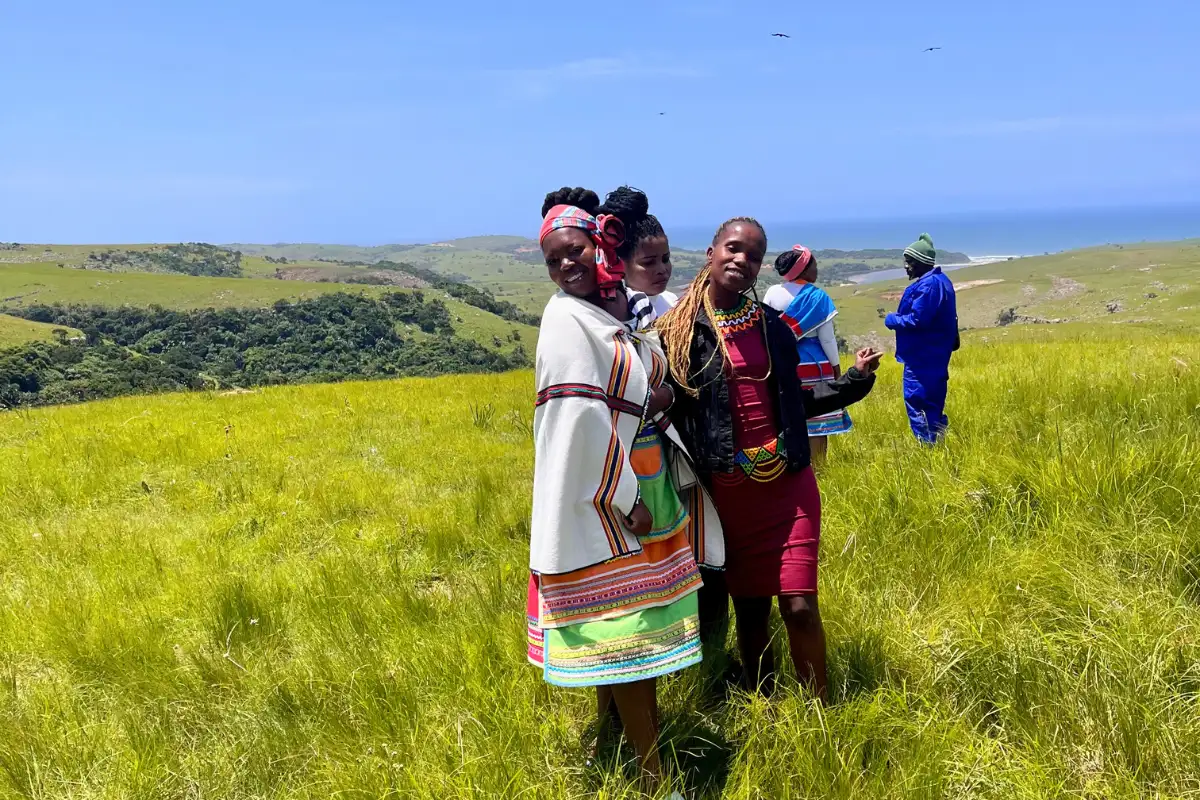
On the Wild Coast, greetings are everything. A simple "Molo" can spark a smile, open conversations, and show respect for the amaMpondo people whose villages and lands you'll walk through. Even if your pronunciation isn't perfect, locals will appreciate the effort.
I've lost count of the moments a single word changed everything on this trail. A hiker who was nervous about the homestay, quietly trying "Kumnandi!" after the first bite of dinner, and suddenly a grandmother across the table was laughing and reaching over to serve them more. Or a child running down a village path who shouted "Molo!" at our group and then dissolved into giggles when someone called it back. These aren't tourist moments. They're real connections, and they cost nothing but a little courage.
Here's a guide to isiXhosa phrases (the broader language spoken in Pondoland) along with amaMpondo dialect variations and trail-specific words that will serve you well on the Mtentu Ramble and beyond.
Table of Contents
- How do you say hello in Xhosa?
- What does Molo mean?
- Why do greetings matter so much here?
- Politeness and Everyday Phrases
- Around Food and Hospitality
- On the Trail
- With Children
- Numbers and Basics
- Pondo Dialect Touches
- How do you pronounce isiXhosa sounds?
- 100 Useful Xhosa Phrases for the Wild Coast
- Tips for Speaking With Locals
- Words Open Doors
How do you say hello in Xhosa?
You say Molo (MOH-loh) to one person, and Molweni (mohl-WEH-nee) to two or more people. That is the whole answer, and those two words will carry you through an entire trip.
What makes it easier than most languages is that Molo works at any time of day or night. There is no separate good morning, good afternoon, or good evening to remember. One word, all day.
Two things will make it land better. The first is to follow the greeting with a name or a title if you know it, which is how isiXhosa speakers actually greet each other and which sounds far warmer than the bare word. The second is simply not to rush it. A greeting here is a small exchange, not a word thrown over your shoulder as you walk past.
If you are greeting a group as you pass through a village, Molweni is the one you want. Getting the singular and plural the wrong way round is the most common slip visitors make, and nobody will mind, but Molweni to a group sounds noticeably more fluent.
- Molo (MOH-loh): Hello (to one person)
- Molweni (mohl-WEH-nee): Hello (to a group; use this when passing a village)
- Bhota (BAW-tah): An informal hi, heard often in the Eastern Cape. Fine between peers and with younger people, but stick to Molo with elders and anyone you are meeting for the first time.
- Unjani? (oon-JAH-nee): How are you? (to one person)
- Ninjani? (neen-JAH-nee): How are you? (to a group)
- Ndiphilile, enkosi. (ndee-pee-LEE-leh, en-KOH-see): I’m well, thank you.
- Siphilile, enkosi. (see-pee-LEE-leh, en-KOH-see): We’re well, thank you. (Use this when someone greets your whole group.)
What does Molo mean?
Molo simply means "hello" in isiXhosa, said to one person. The plural form, Molweni, means the same thing said to two or more people.
It is not a contraction of anything longer and it carries no time-of-day meaning, which is why it works from dawn until well after dark. Nor is it formal or informal in the way English greetings can be; Molo is the neutral, universally correct choice, which is exactly what makes it the one word worth learning before you arrive.
If someone says Molo to you, the polite reply is simply Molo back, usually followed by Unjani? (how are you?). Answer that with Ndiphilile, enkosi and you have held your first full isiXhosa exchange.
Here in Pondoland you will often hear it stretched out and warmed up, closer to "Moooolo" with a rising tone. That is not incorrect pronunciation, it is the local music of the word, and copying it will earn you a smile.
Why do greetings matter so much here?
In amaMpondo culture, passing someone without greeting is considered rude, regardless of whether you know them. This isn't a formality. It's a fundamental acknowledgement of the other person's presence and dignity.
On the trail, you will walk through working villages, past people tending fields, herding cattle, and going about daily life. The greeting comes first, always, before any question or request. It signals that you see them as a person, not scenery.
This one habit, pausing to greet, changes how people respond to you completely. Doors that would otherwise stay closed open. People who might have watched you pass become guides, storytellers, and friends. It sounds like a small thing. On the Wild Coast, it is not.
- Hamba kakuhle. (HAM-bah kah-KOO-hleh): Go well (said to someone leaving).
- Sala kakuhle. (SAH-lah kah-KOO-hleh): Stay well (said when you are the one leaving).
- Uxolo (oo-SAW-loh): Excuse me / Sorry (use to get someone’s attention politely).
- Ndicela uxolo (ndee-SEH-lah oo-SAW-loh): I ask your forgiveness / I’m sorry.
Politeness and Everyday Phrases
- Enkosi: Thank you
- Uxolo: Sorry / Excuse me
- Ewe: Yes
- Hayi: No
- Ndicela…: Please may I have…
- Ungandinceda?: Can you help me?
Around Food and Hospitality
Hospitality is central in amaMpondo culture. You'll likely share meals in homestays, where these phrases come in handy:
- Ndicela Amanzi.: May I have water?
- Kumnandi!: It's delicious!
- Ndiyabulela ngokutya.: Thank you for the food.
- Masiwutye.: Let's eat.
Read more: Traditional Cuisine & Cooking in Pondoland →
On the Trail
These phrases come up often when walking through villages or asking for directions:
- Ngaphi i-ndlela? (ngah-PEE een-dleh-lah): Where is the path/road?
- Kukude na? (koo-KOO-deh nah): Is it far?
- Ndiyabonga ngawe. (ndee-yah-BON-gah ngah-weh): I'm grateful to you.
- Enkosi kakhulu. (en-KOH-see kah-KOO-loo): Thank you very much.
- Ndingancel' uncedo? (ndee-ngahn-TSEH oon-tseh-DOH): Can I ask for help?
- Ndifuna amanzi. (ndee-FOO-nah ah-MAHN-zee): I need water.
- Kukhangeleka kuhle. (koo-khahn-geh-LEH-kah koo-HLEH): It looks beautiful. (Said to a view, a meal, a village: always appreciated.)
With Children
Children along the Wild Coast trail are often the most enthusiastic conversation partners. A few words directed at them, even badly pronounced, will make their day and yours.
- Ungubani igama lakho? (oon-goo-BAH-nee ee-GAH-mah lah-KHO): What is your name?
- Igama lam ngu… (ee-GAH-mah lahm ngoo): My name is…
- Kunjani? (koon-JAH-nee): How are things? (informal, often used with younger people)
- Uyathanda ukugijima? (oo-yah-THAN-dah oo-koo-gee-JEE-mah): Do you like to run? (Great icebreaker near a village)
Don't be surprised if a wave of children decide to walk with your group for half a kilometre. It happens regularly and it's one of the highlights of the trail.
Numbers and Basics
- Inye: One
- Zimbini: Two
- Zintathu: Three
- Ezine: Four
- Zintlanu: Five
- Liphi igumbi lokuhlambela?: Where is the bathroom?
- Ndilahlekile.: I’m lost.
Pondo Dialect Touches
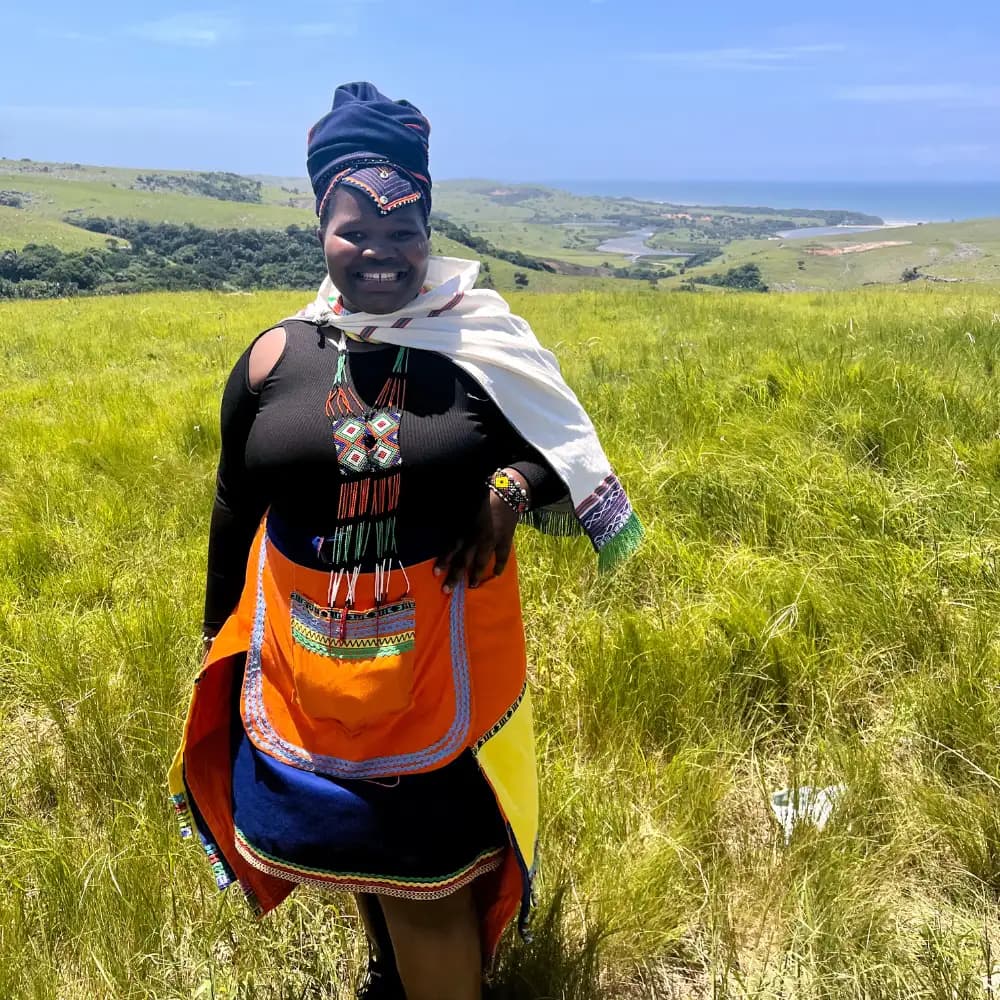
Mpondo woman in vibrant traditional beaded dress standing in coastal grasslands above the Wild Coast, Eastern Cape
The amaMpondo speak isiMpondo, a dialect closely related to isiXhosa but with its own rhythm, vocabulary, and local character. If your standard isiXhosa phrases get a slightly puzzled smile, you've probably wandered into dialect territory. Don't worry; the effort is still read correctly.
A few things you'll notice:
- "Molo" is often elongated here, drawn out with warmth: more like "Moooolo" with a rising tone.
- "Enkosi" (thank you) is used constantly, but you'll also hear "Siyabonga" (see-yah-BON-gah), meaning "we are grateful," which carries a slightly more formal weight.
- Rivers, cattle paths, and land features often have local names that don't appear on maps. Your guide will know them. Ask.
- "Eish!" is not strictly isiXhosa but you'll hear it everywhere in South Africa, including here. It's an all-purpose expression of surprise, sympathy, or emphasis. Use it freely.
- "Hayibo!" (high-BOH): No way! / Unbelievable! Often heard with a laugh. Use it when you see the view from the dunes for the first time.
How do you pronounce isiXhosa sounds?
isiXhosa is famous for its click sounds, and a few of its consonants behave differently from English. Here is how to make each one:
| Sound | How to say it |
|---|---|
| x | Click made by the side of your tongue (like urging a horse). |
| q | Click made with the tip of your tongue (like a cork popping). |
| c | Click made with the front of your tongue (like “tsk-tsk”). |
| hl | A breathy “shl” sound. |
| ty / tsh | Like the English “ch” in “church.” |
100 Useful Xhosa Phrases for the Wild Coast
Xhosa (pronounced KOH-sah) is one of South Africa’s 11 official languages and the mother tongue of most communities along this coastline. We’ve gathered 100 easy Xhosa phrases into a handy downloadable guide, perfect for your next Wild Coast adventure.
You’ll hear its rhythm in everyday greetings, laughter, and song. It’s warm, welcoming, and musical.
A smile and a “Molo” will open more doors than any GPS ever could.
Tips for Speaking With Locals
- Don't worry about mistakes. The effort matters more than accuracy. A mangled "Molweni" still lands better than silence.
- Greet before anything else. Before a question, before a photo request, before anything: greet. This is not optional in amaMpondo culture; it's the baseline of respectful interaction.
- Smile and make eye contact. Language carries tone, but so does your face. A warm look and an attempt at the words together works better than either alone.
- Listen to the rhythm. isiXhosa is musical. Don't try to flatten it into English cadence. Let your ear follow the rise and fall of what you hear before you repeat it.
- Ask your guide to teach you. Our guides grew up speaking isiMpondo and they genuinely enjoy teaching hikers on the trail. Ask them how to say something specific and you'll get a pronunciation lesson and usually a story behind the word.
- Say thank you in their language. Of all the phrases on this page, "Enkosi kakhulu" after a meal or a help received is the one that lands the most warmly. Every single time.
FAQs
How do you say thank you in Xhosa?
"Enkosi." For thank you very much, say "Enkosi kakhulu," and you will also hear "Siyabonga" (we are grateful), which carries a slightly more formal weight. It is the phrase that lands most warmly of all, especially after a meal.
What language do people speak on the Wild Coast?
Most communities along this coastline speak isiXhosa, one of South Africa's official languages. The amaMpondo speak isiMpondo, a dialect closely related to isiXhosa but with its own rhythm and vocabulary.
Do I need to speak Xhosa to hike the Mtentu Ramble?
No. A few greetings and a smile go a long way, and even imperfect pronunciation is appreciated. Your guides grew up speaking isiMpondo and are happy to teach you words on the trail.
Words Open Doors
When you greet a child in isiXhosa or thank a homestay host in their own tongue, you're doing more than using words; you're building a connection. Language here is hospitality, respect, and joy all in one.
At Mtentu Ramble, we encourage travellers to learn and use these simple phrases on the trail. It deepens the experience and shows honour for the people who make the Wild Coast home.
Ready to Experience This Yourself?
The Wild Coast is waiting. Book your guided hike with Mtentu Ramble and create memories that will last a lifetime.